

Orion Nebula: Definition, Visibility, Difference, Formation
The Orion Nebula, known as Messier 42, is a diffuse nebula located in the constellation Orion. It is one of the brightest nebulae in the night sky and is easily spotted with the naked eye due to its close proximity. The nebula has an apparent magnitude of 4.0, making it visible to the unaided eye on a dark, moonless night. Observers often describe it as a gray smudge or fuzzy splotch when viewed without aid.
The Orion Nebula is one of the nearest star-forming nebulae to the solar system. It is a part of the Orion molecular cloud complex, which is one of the most active regions of nearby stellar formation visible in the night sky. This structure is best visible in January and represents a much larger cosmic raw material that lies behind it from the perspective of Earth. The region is one of the most intense areas of stellar formation within the Milky Way Galaxy.
Although the Orion Nebula is completely visible to the naked eye under ideal conditions, binoculars or a telescope enhance its details significantly. Its hazy appearance makes it easily identifiable even for amateur astronomers. This bright diffuse nebula serves as a key observational target for studying stellar birth and evolution.
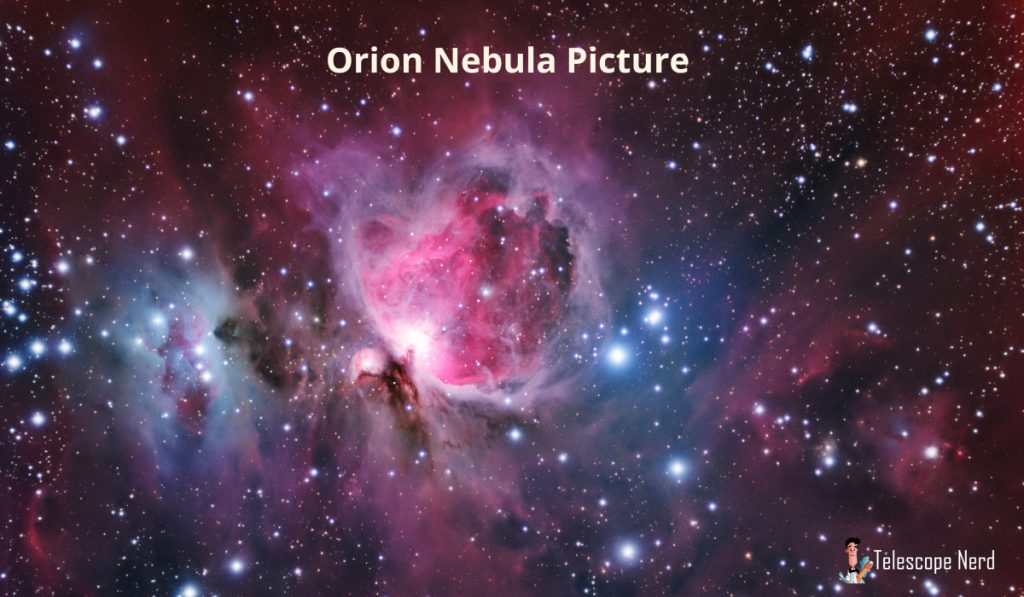
What is the Orion Nebula?
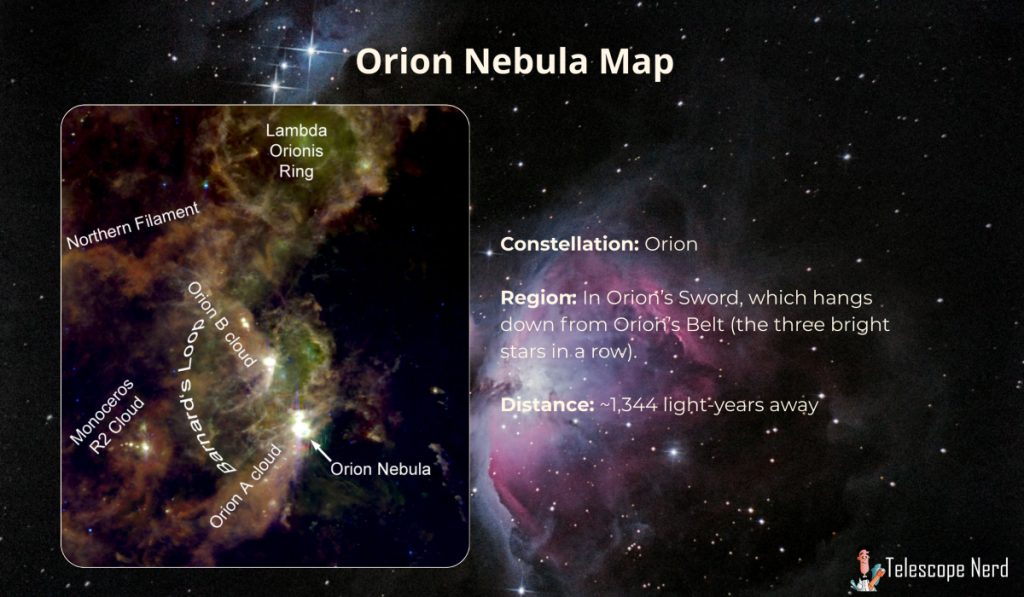
The Orion Nebula is an enormous cloud of dust and gas, and it is the closest region of massive star formation to Earth. Located approximately 1,350 light-years away, the Orion Nebula is one of the most active star-forming regions and has revealed much about the process of how stars and planetary systems are formed.
The Orion Nebula, known as NGC 1976, is noted as M42 in the Messier Catalogue. The Orion Nebula is situated south of Orion’s Belt. The nebula is known as the middle “star” in the “sword” of Orion. Messier 42 can be spotted with the unaided eye from a dark sky site. The nebula has an apparent magnitude of 4. Its position is Right Ascension 5h 35m and Declination 5 degrees 23′ south (2.83 degrees south).
The Orion Nebula is a diffuse nebula and part of the Orion molecular cloud complex. This region is a stellar nursery where new stars are forming. The Trapezium Cluster, an asterism, lies within this star-forming region. Gas and dust within the molecular cloud provide the material for ongoing star formation. The Orion Nebula remains a key object of study in understanding stellar evolution.
Who made the discovery of the Orion Nebula?
The discovery of the Orion Nebula is attributed to multiple astronomers. Nicolas-Claude Fabri de Peiresc made the first known observation. He used a refracting telescope in the early 17th century. Christian Huygens provided a detailed description later. His observations occurred in the mid-1600s. The nebula gained attention due to its brightness, becoming a subject of study for many scientists. Visibility and the nebula’s prominence in the night sky aided these discoveries. Further advancements in telescopes refined observations, allowing astronomers to study it more thoroughly over time.
Is the Orion Nebula visible with the naked eye?
The Orion Nebula is visible with the naked eye. The nebula is one of the brightest nebulae in the night sky. The Orion Nebula has an apparent magnitude of 4.0, making it visible even from areas affected by light pollution. Orion Nebula is visible in the northern skies from November to March, best observed during January.
The Trapezium is a group of four massive stars located in the Orion Nebula. These stars are arranged in a trapezoidal pattern. The nebula shows photo-ionizing effects of massive nearby stars. Such features make the Orion Nebula a notable diffuse nebula.
What stars are in the Orion Nebula?
The Orion Nebula contains about 2,800 stars within a diameter of 20 light years. The bright, central region of the nebula is the home of four massive, young stars. These stars are known as the Trapezium Cluster. Small telescopes can see the four brightest stars in the Orion Nebula. The Trapezium Cluster has 11 stars in the tight central group.
Ultraviolet light from the Trapezium stars is carving a cavity in the nebula. This ultraviolet light disrupts the growth of hundreds of smaller stars. Stars in the Orion Nebula are still forming today. The Orion Nebula contains hundreds of very hot (O-type) young stars. Observations of the nebula have revealed approximately 700 stars. The Hubble image of the Orion Nebula showed over 3,000 stars of different sizes.
The Trapezium Cluster is a part of the much larger Orion Nebula cluster. The Orion Nebula region has over 2,000 new stars in the immediate neighborhood. New stars are part of this stellar nursery. The light of the Trapezium stars illuminates the Orion Nebula. Ultraviolet light is disrupting the growth of hundreds of smaller stars.
Runaway stars AE Aurigae, 53 Arietis, and Mu Columbae are moving away from the nebula at speeds greater than 100 km/s (62.14 mph). The stars that make up the belt are about 8 million years old. Orion Belt’s stars are located midway between Betelgeuse and Rigel. The three stars of Orion’s Belt are a short, straight row of medium-bright stars.
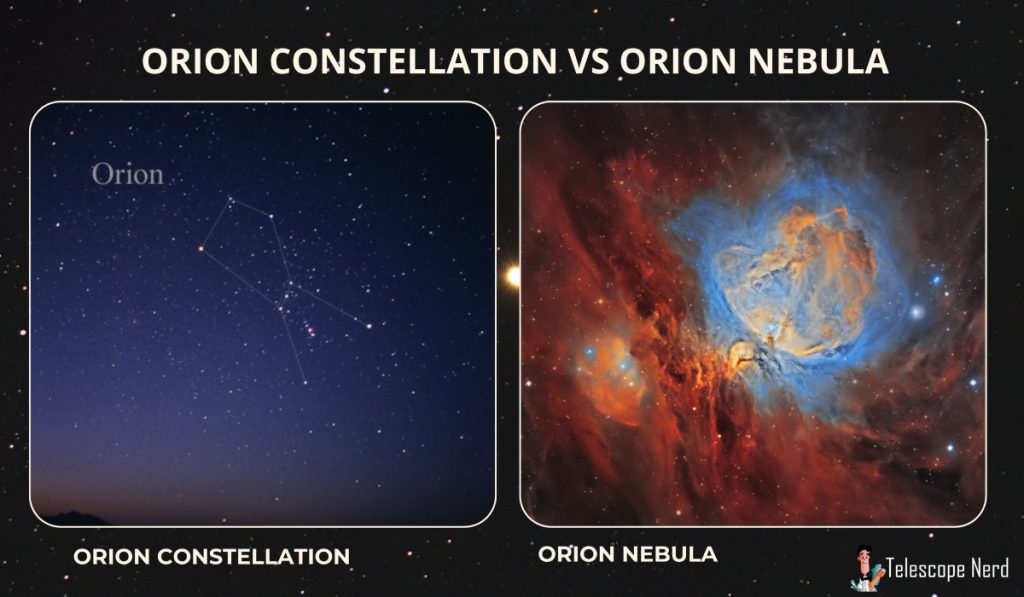
What is the difference between the Orion Nebula and the Orion Constellation?
The Orion Nebula and the Orion constellation are distinct astronomical entities. The Orion Nebula is part of the Orion constellation, appearing as a fuzzy “star” in the middle of Orion’s sword. This star-like entity is the Orion Nebula, one of the most notable nebulae in the Orion constellation. The Orion Nebula is a vast star-forming region located within the Orion constellation. The Orion Nebula is situated south of the Orion Belt and is one of the most notable nebulae in the night sky.
The Orion constellation lies near the celestial equator, visible from around the world. The constellation is the 26th of the 88 modern constellations, covering 594 square degrees. Orion’s seven brightest stars form an hourglass-shaped pattern in the night sky. Four stars – Rigel, Betelgeuse, Bellatrix, and Saiph – form a roughly triangular shape. At the center of this lie three stars of the Orion’s Belt – Alnitak, Alnilam, and Mintaka. Betelgeuse, designated as Alpha Orionis, is a massive red supergiant star, and the second brightest star in the Orion constellation. Rigel, known as Beta Orionis, is the sixth brightest star in the night sky.
The Orion constellation is a collection of several nebulae in the night sky of which the Orion Nebula is a part. The Orion molecular cloud complex spans the whole Orion Constellation. The Orion Nebula is one feature within the constellation, and the constellation itself encompasses a broader area and includes multiple stars and features.
Does the Orion Nebula contain planets?
The Orion Nebula contains large numbers of protoplanetary disks and protostars. These disks are where planets are born. Protoplanetary disks contain dust grains that are growing. Observations of the Orion Nebula using the JWST and ALMA yielded direct imagery of an exoplanet forming from the protoplanetary disk of HOPS-315. HOPS-315 is a protostar within the Nebula. HOPS-315 is in the active phase of its formation. Intense ultraviolet radiation illuminates protoplanetary disks.
JWST found hundreds of planetary-mass objects in the Orion Nebula. Webb found 540 planetary mass objects in Orion Nebula. Observations confirm that the number of planet-sized objects is far greater than previously thought. The Orion Nebula contains dozens of Jupiter-sized planets. These celestial bodies are free-floating planets without stars. These celestial bodies are failed stars known as brown dwarfs.
Astronomers reported the discovery of pairs of rogue planets similar in mass to the planet Jupiter and are called JuMBOs. JuMBOs are located in Orion Nebula. JWST discovered pairs of unusual planet-like binary objects drifting freely in space.
How did the Orion Nebula form?
The Orion Nebula formed through a process that reveals much about how stars and planetary systems are created from collapsing clouds of gas and dust. Interstellar clouds begin as gravitationally bound blobs of cold, neutral hydrogen, intermixed with traces of other elements. These clouds contain hundreds of thousands of solar masses and extend for hundreds of light-years. In the last few million years, about 3000 young stellar objects were formed in Orion A, which has a mass in the order of 10^5 solar masses.
The strong wind from the newly formed star at the heart of the Orion Nebula is creating a bubble. This radiation pushed interstellar gas and dust away in an expanding bubble. Parts of the bubble’s surface grew dense enough to collapse, forming new stars. Ultraviolet light unleashed by these stars is carving a cavity in the nebula. The temperature of the H II region falls dramatically near the edge of the nebula. Ultraviolet light unleashed by these stars is disrupting the growth of hundreds of smaller stars.
Orion OB1d is the youngest group, with an age of less than 2 million years. The Orion Molecular Cloud Complex includes M43, the Horsehead Nebula, and M78. θ 1 Orionis C emits 3‑4 times as much photoionizing light as the next brightest star. Orion A is about 1300 light-years away. The wind from the newly formed star at the heart of the Orion Nebula is preventing new stars from forming in its neighborhood.
